The 2026 CrossFit Games Could Mark the Beginning of a New Era

Every year, predictions surrounding the CrossFit Games walk a dangerous line between analysis and fantasy.

The sport changes too quickly. Programming remains unpredictable. Injuries can alter the leaderboard overnight. One failed lift, one brutal endurance event, or one strategic mistake can erase an entire season’s worth of preparation.

But heading into the 2026 season, one thing feels increasingly clear:

CrossFit is entering a transition period.

The dominant era of untouchable champions appears to be fading, replaced by a younger, deeper, and increasingly volatile field where multiple athletes now look capable of taking control of the sport’s future.

And when the Games arrive at SAP Center this July, the competition may feel less like a continuation of the past and more like the start of something entirely new.

Jayson Hopper and the Pressure of Staying on Top

The men’s division begins with one unavoidable question:

Can Jayson Hopper do it again?

Winning a CrossFit championship changes an athlete’s reality instantly. Expectations become heavier. Weaknesses become more visible. Every performance is scrutinized through the lens of defending a title.

Hopper enters 2026 no longer as an emerging talent, but as the man everyone is chasing.

Physically, he has the tools to repeat. His explosiveness remains elite. His gymnastics efficiency and competitive intensity make him one of the most dangerous athletes in nearly any event format. More importantly, his overall consistency improved dramatically during his championship run.

The challenge now becomes managing pressure.

CrossFit history has repeatedly shown that defending a title is often harder than winning the first one. The psychological burden alone can derail even the most gifted athletes.

Still, Hopper appears built for the spotlight.

If he avoids catastrophic finishes during endurance-heavy events and maintains composure deep into the weekend, another podium finish feels highly realistic — and a repeat title is entirely possible.

Roman Khrennikov’s Window May Be Narrowing

No athlete carries more emotional support entering 2026 than Roman Khrennikov.

For years, Khrennikov has remained near the top of the sport despite injuries, setbacks, and circumstances that repeatedly interrupted momentum. Yet he continues to survive every challenge the Games throw at him.

That resilience has transformed him into one of the most respected competitors in CrossFit.

But time matters.

The men’s field is becoming younger, faster, and deeper every season. Athletes entering the sport now are arriving with refined movement patterns, advanced recovery strategies, and years of CrossFit-specific preparation from an early age.

Khrennikov still possesses elite strength and conditioning, but 2026 increasingly feels like one of his best remaining opportunities to capture a championship before the next generation fully takes over.

And if he finally wins in San Jose, it may become one of the most celebrated moments in modern CrossFit history.

Emma Lawson Looks Ready Right Now

For years, Emma Lawson has been described as the future of women’s CrossFit.

That language may already be outdated.

Lawson no longer looks like a developing athlete trying to gain experience. She increasingly looks like a legitimate title contender.

What separates Lawson is not simply athleticism — although she possesses plenty of that. It is her composure. She rarely appears emotionally rattled, even during high-pressure moments. Her pacing remains controlled. Her movement quality rarely deteriorates under fatigue. Most importantly, she avoids disastrous finishes.

In modern CrossFit, that consistency often matters more than spectacular event wins.

The women’s field is entering a fascinating transition phase. The dominance of past eras has given way to a far more competitive landscape where multiple athletes appear capable of winning major events.

Lawson appears positioned directly at the center of that shift.

If her strength progression continues, 2026 could become the season she officially arrives as one of the faces of the sport.

Haley Adams May Become the Emotional Story of the Games

While some athletes chase championships, Haley Adams enters 2026 carrying a different type of narrative.

After openly discussing burnout, mental health struggles, and stepping away from competition, Adams’ return has become about far more than leaderboard placement.

Her honesty reshaped conversations surrounding athlete wellness within CrossFit culture. In a sport that often glorifies endless grinding and emotional suppression, Adams reminded fans that elite athletes are still human beings.

Now she returns healthier, more balanced, and perhaps more dangerous than many realize.

At her best, Adams remains one of the premier conditioning athletes in the field. If programming emphasizes endurance, bodyweight movement, and pacing strategy, she could immediately disrupt the leaderboard.

Whether she reaches the podium or not, her presence alone may become one of the defining emotional storylines of the Games.

The Women’s Division Has Never Been Deeper

Perhaps the most significant development entering 2026 is the growing parity within the women’s field.

Athletes like:

  • Emma Lawson

  • Paige Rodgers

  • Laura Horvath

  • Lucy Campbell

  • Olivia Kerstetter

are creating a division where no single athlete appears untouchable anymore.

That unpredictability changes everything.

Instead of watching one dominant champion slowly separate from the field, fans may witness constant leaderboard movement throughout the weekend. The margin between first and fifth could become razor thin.

For spectators, that level of uncertainty creates drama the sport has not consistently seen in years.

San Jose Could Change the Feel of the Sport

The move to SAP Center may subtly reshape the Games themselves.

Arena-based competition tends to create:

  • faster pacing,

  • louder environments,

  • more direct athlete battles,

  • and greater crowd influence.

That atmosphere often benefits explosive competitors and athletes who thrive emotionally in head-to-head racing formats.

It also returns CrossFit to California, where the sport was originally born.

For the 20th edition of the Games, that symbolism feels significant.

A Sport in Transition

More than anything else, the 2026 season feels like a bridge between generations.

Veterans are still dangerous. Champions are still standing. But younger athletes are no longer waiting patiently for their turn.

They are arriving now.

The modern CrossFit athlete is more specialized, more technically refined, and more professionally prepared than ever before. Recovery science, nutrition, movement efficiency, and sports psychology have become as important as raw fitness itself.

The result is a Games field that may be deeper and more unpredictable than any before it.

And that unpredictability is exactly what makes this season so compelling.

Because for the first time in years, the question entering the CrossFit Games is not simply who can defend a title.

It is who will define the next era of the sport.

The Biggest Storylines Heading Into the 2026 CrossFit Games

The road to the 2026 CrossFit Games in San Jose is beginning to take shape, and this season already feels different.

The sport is entering a transitional moment. Established legends are still standing, rising stars are no longer just prospects, and a new generation of athletes is beginning to challenge the hierarchy that defined CrossFit for the better part of a decade.

From redemption stories to title defenses, here are the biggest narratives building momentum heading into July.

Can Jayson Hopper Repeat?

Jayson Hopper enters 2026 with a completely different target on his back.

After capturing the men’s title at the 2025 Games, Hopper is no longer viewed as a talented athlete with potential. He is now the defending champion — and history has shown that winning once is very different from staying on top.

The pressure changes everything.

Opponents study weaknesses more aggressively. Expectations rise. Every event becomes a test not only of fitness, but of composure under the weight of defending a crown.

Hopper’s athleticism has never been questioned. His explosiveness, gymnastics capacity, and intensity make him one of the most dangerous competitors in the sport. The bigger question is whether he can maintain consistency across another full season against an increasingly deep men’s field.

If he does repeat, it would cement him as the face of the post-Fraser era.

Roman Khrennikov’s Last Push for a Title?

Roman Khrennikov remains one of the most respected athletes in CrossFit — and one of the most emotionally compelling.

For years, Khrennikov has battled injuries, visa complications, and heartbreaking near-misses while still remaining near the top of the leaderboard. His runner-up finish at the 2026 Mayhem Classic again proved he remains among the elite.

But time matters in CrossFit.

The sport is younger, deeper, and more athletic than ever before. Khrennikov still possesses world-class strength and work capacity, but the question looming over 2026 is whether this represents one of his final realistic opportunities to win the Games outright.

Fans continue to rally behind him because his career has become about perseverance as much as performance.

And if he finally captures the title in San Jose, it may become one of the sport’s most celebrated championship moments.

The Women’s Division Is Entering a New Era

The women’s field may be undergoing the biggest transformation in the sport.

For years, nearly every major storyline revolved around Tia-Clair Toomey and her historic dominance. Now, younger athletes are beginning to establish themselves as legitimate threats rather than future possibilities.

Athletes like:

  • Emma Lawson

  • Paige Rodgers

  • Lucy Campbell

  • Olivia Kerstetter

are no longer simply gaining experience. They are winning major qualifying events and entering Games conversations as potential podium athletes.

That generational shift creates one of the most fascinating dynamics of the season:
Can the veterans maintain control, or has the next era officially arrived?

Haley Adams’ Redemption Arc

Haley Adams may not currently be the betting favorite to win the Games, but few athletes carry more emotional support from the fan base.

After openly discussing burnout, mental health struggles, and stepping away from competition, Adams’ return has become bigger than leaderboard placement. Her performance at the Mayhem Classic showed flashes of the athlete fans remember, including an event win and moments of elite conditioning.

The question entering 2026 is not simply whether she can qualify consistently again.

It is whether a healthier, more balanced version of Adams can rediscover the confidence that once made her one of the sport’s brightest stars.

And if that happens, she immediately becomes dangerous.

Is This Finally the Year for Europe?

International athletes are no longer chasing American dominance — they are actively reshaping the sport.

Athletes from Europe continue flooding the top of leaderboards, and 2026 already reflects that trend. Victor Hoffer’s victory at the Mayhem Classic reinforced the growing international depth in the men’s division.

Meanwhile, athletes from Iceland, Australia, Canada, and across Europe continue producing elite contenders at nearly every stage of the season.

CrossFit’s center of gravity is becoming increasingly global.

The question now is whether the 2026 podiums will fully reflect that shift.

San Jose Changes the Atmosphere

The move to SAP Center for the Games’ 20th anniversary introduces another major storyline.

California carries symbolic weight in CrossFit history. The sport was born there, and returning west for such a milestone season feels intentional.

The venue itself may also change the feel of competition:

  • Faster-paced arena events

  • Louder crowds

  • More spectator-focused programming

  • Different climate and recovery conditions

Every Games location subtly alters the competition. Veterans who adapt quickly usually gain an advantage.

The Sport Is Evolving Again

Perhaps the biggest storyline is broader than any single athlete.

CrossFit itself is changing.

The athletes are younger. The training is more scientific. Recovery, nutrition, psychology, and specialization now play massive roles in performance. The gap between contenders and mid-level Games athletes continues shrinking.

That means 2026 may become one of the most unpredictable seasons in recent memory.

And unpredictability is exactly what makes the CrossFit Games compelling.

Paige Rodgers Is Quietly Becoming One of CrossFit’s Most Dangerous Athletes

In a sport often dominated by massive personalities and headline-grabbing moments, Paige Rodgers has built her rise differently.

No dramatic theatrics. No manufactured persona. No constant noise surrounding every performance.

Instead, Rodgers has done something that may ultimately matter more in the modern era of the CrossFit Games:

She keeps getting better.

Year after year, workout after workout, Rodgers has steadily evolved from a respected competitor into one of the most complete and dangerous athletes in the women’s field. While attention often shifts toward bigger names and younger phenoms, her consistency and discipline have quietly positioned her among the elite contenders entering the 2026 season.

And at this point, calling her an underdog may no longer make sense.

Built Through Consistency

CrossFit rewards versatility unlike almost any other sport.

Athletes are expected to sprint, lift maximal loads, swim, climb ropes, perform elite gymnastics, and endure brutal endurance events — often all within the same weekend. The margin separating the podium from the middle of the leaderboard is razor thin.

Rodgers’ greatest strength may be her ability to minimize weakness.

She rarely implodes during events. Rarely appears overwhelmed. Rarely gives away unnecessary points. That level of consistency becomes increasingly valuable as the field deepens and the sport grows more competitive each season.

Many athletes can produce spectacular moments. Fewer can sustain excellence across an entire competition weekend.

Rodgers has steadily become one of those athletes.

The Evolution of a Contender

What makes Rodgers especially dangerous is that her development has appeared methodical rather than accidental.

Over time, her performances have reflected increasing maturity in pacing, strategy, movement efficiency, and composure under pressure. The physical tools were always present, but experience has sharpened how she applies them in competition.

That evolution is often what separates Games qualifiers from true title contenders.

The modern women’s field is brutally deep. One bad event can destroy an otherwise elite weekend. Athletes who remain mentally steady while adapting to unpredictable programming usually rise to the top.

Rodgers increasingly looks like an athlete capable of surviving that chaos.

The New Era of Women’s CrossFit

The women’s division is entering a transition period.

For years, the sport revolved around dominant veterans whose consistency created an almost impossible standard for challengers. Now, a new wave of athletes is beginning to emerge — competitors who grew up inside the CrossFit ecosystem and understand the demands of the Games from an early age.

Rodgers fits uniquely within that changing landscape.

She combines veteran-level experience with continued upward momentum, making her one of the more intriguing athletes to watch heading into the 2026 season. While younger stars generate excitement and established legends continue to command attention, Rodgers occupies a dangerous middle ground: experienced enough to manage pressure, but still improving physically and competitively.

That combination can produce breakthrough seasons.

Quiet Confidence

One of the most noticeable aspects of Rodgers’ competitive style is the absence of panic.

Elite CrossFit competitions are designed to create stress. Athletes are forced into uncomfortable positions, unexpected movements, and brutal fatigue. Emotional control becomes a competitive advantage.

Rodgers often appears remarkably composed regardless of circumstance.

That calm demeanor matters more than casual observers realize. In high-level competition, wasted emotional energy can become a liability. Athletes who remain efficient mentally often stay efficient physically.

Championship-level CrossFit increasingly resembles endurance warfare — not just physically, but psychologically.

Rodgers appears built for that environment.

Why 2026 Could Be Different

Every season produces athletes who feel poised for a leap.

Rodgers increasingly looks like one of them.

The physical capacity is there. The experience is there. The confidence appears to be growing. Most importantly, her trajectory continues moving upward at a time when the women’s field is becoming more volatile and unpredictable.

That does not guarantee a podium finish. The CrossFit Games remain one of the most unforgiving competitions in sports.

But it does mean Rodgers can no longer be viewed simply as a participant capable of qualifying.

She is entering the conversation as an athlete capable of seriously disrupting the leaderboard.

And if her progression continues, it may only be a matter of time before Paige Rodgers stops being described as a rising competitor and starts being described as one of the defining athletes of this new era in CrossFit.

Haley Adams and the Fight to Rediscover Joy in CrossFit

For years, Haley Adams represented one of the brightest young stars in the CrossFit Games ecosystem.

She was relatable, gritty, undersized by elite CrossFit standards, and relentlessly determined. Fans gravitated toward her authenticity as much as her performances. In a sport increasingly dominated by polished branding and machine-like consistency, Adams felt human.

That humanity may ultimately become the most important part of her story.

Because Haley Adams’ recent career has not simply been about podiums, rankings, or workouts. It has become a much larger conversation about pressure, burnout, identity, and what happens when one of the sport’s most recognizable athletes decides that surviving mentally matters more than competing endlessly.

The Rise of a Fan Favorite

Adams burst onto the elite scene at a young age and quickly built a reputation as one of the toughest competitors in the women’s division.

Despite lacking the sheer size and power of many rivals, she consistently outperformed expectations through conditioning, grit, and relentless effort. Fans watched her attack workouts with visible emotion and determination, often pushing through events with an intensity that made her instantly memorable.

Her style resonated because it looked attainable in a sport increasingly filled with superhuman performances.

She wasn’t the biggest lifter on the floor. She wasn’t the most physically imposing athlete. Yet she repeatedly proved she belonged among the best in the world.

That underdog identity helped make Adams one of CrossFit’s most popular athletes.

The Pressure of Constant Competition

But elite CrossFit comes at a cost.

The modern Games season is physically punishing, emotionally exhausting, and mentally consuming. Training volume can feel endless. Recovery becomes a full-time responsibility. Every weakness is exposed publicly, analyzed online, and discussed across social media.

For athletes who grow up inside that environment, the pressure can quietly become overwhelming.

Adams eventually stepped back from competition and openly discussed struggles related to burnout, mental health, and disordered eating — topics that have historically remained uncomfortable conversations within functional fitness culture.

Her honesty immediately shifted the tone of the conversation surrounding elite CrossFit.

Instead of pretending that suffering was simply part of the game, Adams acknowledged the emotional realities many athletes experience behind the scenes. For many fans, it was the first time a major CrossFit athlete spoke openly about the psychological strain created by the sport’s relentless demands.

Redefining Strength

What made Adams’ story resonate was that her vulnerability did not feel manufactured.

There was no polished corporate messaging. No carefully scripted redemption arc. Instead, there was a young athlete trying to figure out who she was outside constant competition.

In many ways, that honesty expanded her influence far beyond the competition floor.

CrossFit culture has long celebrated extreme discipline, sacrifice, and pushing through pain. Adams introduced a more nuanced message: that health is not simply physical, and that stepping away can sometimes require more courage than continuing to compete.

For younger athletes especially, that message mattered.

The sport continues to evolve physically, but it is also being forced to mature emotionally. Conversations about recovery, mental health, sustainability, and identity are becoming increasingly unavoidable as athletes face longer seasons, greater scrutiny, and growing commercial expectations.

Adams helped accelerate those conversations.

The Return

Now, as she re-emerges within the competitive landscape, the narrative surrounding Adams feels different.

The expectations are no longer solely about whether she can stand on a podium. Instead, many fans simply want to see her healthy, enjoying the sport again, and competing on her own terms.

Ironically, that mindset may make her more dangerous than ever.

When Adams is physically healthy and emotionally engaged, she remains one of the most capable conditioning athletes in the field. Her engine, pacing ability, and competitive toughness still make her a threat in nearly any endurance-heavy event.

And while newer stars continue rising through the ranks, experience still matters at the highest levels of the Games.

Adams understands the pressure of the spotlight. She understands the emotional swings of competition weekends. Most importantly, she understands what it feels like to lose herself inside the sport — and what it takes to fight back.

More Than Results

Whether Haley Adams ultimately returns to podium contention almost feels secondary to the larger significance of her journey.

In a culture that often glorifies endless grinding, she reminded people that athletes are not machines.

Her career has become about more than fitness. It has become about balance, identity, resilience, and learning that worth cannot be measured solely by leaderboard standings.

That perspective may end up being her greatest contribution to CrossFit.

Because while championships define careers, honesty changes culture.

And Haley Adams has already done that.

Emma Lawson’s Rise Signals a Changing of the Guard in Women’s CrossFit

For years, the women’s division at the CrossFit Games has been defined by dominance. Athletes like Tia-Clair Toomeyreshaped expectations of what was physically possible, creating an era where winning the Games often meant surviving a near-perfect performance from the top of the leaderboard.

Now, another name is steadily moving into that conversation: Emma Lawson.

At just 20 years old, Lawson has already become one of the most compelling athletes in the sport — not simply because of her performances, but because of the way she performs. In a sport built on chaos, fatigue, and pressure, Lawson competes with a level of calm and consistency that feels far beyond her years.

That combination is why many in the CrossFit community increasingly view her as one of the future faces of the women’s division.

More Than a Breakout Athlete

CrossFit has seen plenty of young phenoms flash brilliance for a season before fading under the weight of expectations, injuries, or the relentless grind of the sport. Lawson appears different.

Rather than relying on one dominant specialty, her rise has been built on completeness.

She moves efficiently. She paces intelligently. She rarely panics during workouts. Most importantly, she avoids disastrous finishes — one of the defining traits of elite Games athletes.

In modern CrossFit, consistency often matters more than spectacular event wins. A competitor who repeatedly finishes near the top will almost always outperform athletes who swing wildly between first and fifteenth place.

Lawson seems to understand that already.

Across endurance workouts, gymnastics-heavy events, and mixed-modal tests, she has shown an ability to remain composed while other athletes begin to unravel. That steadiness has quickly transformed her from a promising prospect into a legitimate contender.

The Mental Side of the Sport

Physical talent alone does not win the CrossFit Games.

The competition stretches across multiple days and tests nearly every imaginable capacity: strength, conditioning, skill, recovery, pacing, adaptability, and resilience. The athletes who thrive are often the ones who can remain emotionally controlled while exhausted and under pressure.

Lawson’s composure may be the most impressive part of her rise.

Even during high-profile moments on the competition floor, she rarely appears rattled. There is little wasted movement, little visible panic, and little emotional volatility. Her performances often look methodical rather than desperate — a trait more commonly seen in seasoned veterans than in athletes still early in their careers.

That poise has drawn comparisons to Toomey, whose dominance was built as much on mental consistency as physical superiority.

The comparison is not about matching Toomey’s accomplishments — at least not yet. Rather, it reflects a similar competitive maturity that is unusual for such a young athlete.

A Changing Women’s Division

The timing of Lawson’s emergence matters.

The women’s field is entering a transition period. Veteran stars who have dominated headlines for years are moving deeper into their careers, while a younger generation is beginning to mature into true championship threats.

Lawson sits directly at the center of that shift.

She represents the next evolution of the sport: athletes who grew up watching modern CrossFit, training specifically for it from a younger age, and developing highly refined movement patterns before reaching their physical peak.

Unlike earlier generations that often transitioned into CrossFit from other sports, many younger competitors now arrive already molded by the demands of the Games environment.

Lawson appears to embody that evolution.

The Remaining Questions

Despite her rapid ascent, Lawson’s development is still ongoing.

The biggest remaining question is whether she can continue building the raw power and durability necessary to consistently win against the strongest women in the world. As athletes mature, maintaining health through increasingly brutal training volumes becomes one of the sport’s greatest challenges.

Heavy barbell cycling, maximal strength under fatigue, and long-weekend recovery remain critical areas that often separate podium contenders from champions.

Still, Lawson’s trajectory suggests those gaps may continue narrowing.

And perhaps most importantly, she appears unfazed by the expectations that now follow her into every major competition.

Why 2026 Could Be a Turning Point

The 2026 season feels increasingly significant for the future of women’s CrossFit.

As the sport prepares for another chapter at the SAP Center in San Jose, emerging stars are no longer simply chasing experience — they are chasing titles.

Lawson has already proven she belongs among the elite. The next step is determining whether she can take control of the sport’s next era.

That may not happen overnight. CrossFit history has shown how difficult it is to consistently stay at the top against the deepest fields in the world.

But if her progression continues at its current pace, it is becoming harder to view Emma Lawson merely as the future of the sport.

She is rapidly becoming its present.

Jeffrey Adler and the Burden of Staying on Top

Winning the CrossFit Games changes an athlete forever.

Not just publicly.
Internally.

The climb to the top of CrossFit is brutal enough. Years of obsessive training, injuries, sacrifice, scrutiny, and survival all funnel toward one singular goal: proving you are the fittest athlete on Earth. But once an athlete finally reaches that summit, a different pressure emerges almost immediately.

Now you have to stay there.

For Jeffrey Adler, that challenge may define the next phase of his career more than the championship itself.

Because becoming champion transformed Adler from a respected contender into something far more dangerous: the standard everyone else is now chasing.

And heading into the 2026 season, one question looms over the men’s division more than any other:

Was Jeffrey Adler’s title the culmination of a great season—or the beginning of an era?

Adler’s rise never carried the same cinematic mythology as some of CrossFit’s larger personalities.

There was no dramatic reinvention.
No endless controversy.
No carefully marketed narrative arc.

Instead, Adler built himself through something less flashy and far more sustainable: relentless consistency.

Year after year, the Canadian athlete quietly evolved from respected competitor into one of the most complete athletes in the sport. While others dominated headlines with spectacular event wins or emotional storylines, Adler developed the type of profile elite competitors fear most—the athlete with almost no weaknesses.

In CrossFit, that matters more than brilliance.

The Games are not designed to reward perfection in isolated moments. They reward survival across chaos. The champion is rarely the athlete who looks most dominant for one afternoon. It is usually the athlete who refuses to collapse when the competition becomes unpredictable.

That is where Adler separated himself.

His greatness emerged not through spectacle, but through control.

While other athletes surged and faded, Adler remained stable. While others chased event wins recklessly, he accumulated points methodically. He became exceptionally difficult to damage across a full competition weekend, which is ultimately what championships require.

And perhaps most importantly, he learned how to manage pressure.

Pressure destroys many elite athletes long before injury does.

The modern CrossFit landscape magnifies everything. Every workout is dissected online within minutes. Every leaderboard swing becomes a narrative. Every weakness becomes public conversation. Athletes are expected to maintain elite conditioning while simultaneously functioning as media personalities, sponsors, content creators, and public brands.

Some competitors thrive under that scrutiny.

Others fracture beneath it.

Adler appears uniquely built for it.

There is an emotional steadiness to the way he competes that has become increasingly rare in modern CrossFit. He rarely looks panicked. Rarely looks overwhelmed. Rarely appears consumed by the emotional chaos unfolding around him on the competition floor.

That calmness is deceptive.

Because underneath it sits one of the fiercest competitive engines in the sport.

Adler does not need to dominate every event to control a leaderboard. He understands something many athletes struggle to fully embrace: the Games are won through accumulation, not emotion.

That philosophy helped elevate him from contender to champion.

Now it may determine whether he stays there.

The difficulty of defending a CrossFit title is often underestimated outside the sport.

Winning once is historically difficult.
Repeating is exponentially harder.

The moment an athlete becomes champion, they immediately inherit the psychological weight of expectation. Every competitor studies them differently. Every weakness becomes targeted. Every event suddenly carries the burden of validation.

The field stops asking whether you can win.

Now they ask whether they can take it from you.

For Adler, that dynamic becomes especially fascinating entering the 2026 season because the men’s field may be deeper and more dangerous than it has been in years.

Roman Khrennikov remains one of the most physically terrifying athletes in the sport when healthy. Younger stars continue emerging with increasingly advanced athletic backgrounds. Veterans refuse to disappear quietly. Specialists are evolving into complete athletes faster than previous generations ever managed.

And yet, Adler still may be the most structurally difficult athlete to beat over four days.

Because while others possess explosive strengths, Adler’s greatest weapon is balance.

He does not require ideal programming to contend.
He does not depend on one dominant category.
He does not unravel easily under pressure.

In a sport specifically designed to expose flaws, Adler has spent years systematically eliminating his.

That makes him exceptionally dangerous.

There is also a growing maturity to Adler’s presence within the sport.

Earlier in his career, he often felt like an athlete trying to break into the elite tier. Now he carries himself like someone fully aware that he belongs there permanently.

Championships change how athletes move.

You can see it in body language. Decision-making. Patience. The absence of desperation.

Adler no longer competes like a man hoping to prove himself worthy of the title conversation. He competes like someone who understands the conversation begins with him.

That distinction matters.

The best champions in CrossFit history shared a similar trait: they forced the field to react to them psychologically before workouts even began. Opponents stopped viewing them as merely another competitor and began viewing them as the obstacle standing between themselves and greatness.

Adler is entering that territory now.

And unlike some champions who rely heavily on momentum or emotion, Adler’s style may age exceptionally well. His success is built less on reckless athleticism and more on efficiency, preparation, pacing intelligence, and emotional control.

Those qualities tend to survive longer.

The move to San Jose for the 2026 CrossFit Games adds another layer of intrigue.

New venues reshape competitions in subtle but important ways. Arena pacing changes. Crowd energy changes. Recovery logistics change. Athletes who adapt quickly often gain enormous advantages early in the weekend.

Historically, Adler has thrived in precisely those environments.

He rarely appears rattled by unpredictability. In fact, chaos often seems to strengthen his competitive approach because he trusts his preparation enough to remain composed while others emotionally overextend themselves.

That composure may become critical if the 2026 programming trends heavier, longer, or more volatile than expected.

Because while explosive event wins create highlights, championships are still built on minimizing damage.

Few athletes in modern CrossFit do that better than Jeffrey Adler.

There is a temptation in elite sports to constantly search for the next superstar.

The next phenom.
The next viral athlete.
The next dramatic rise.

But sustained greatness rarely looks dramatic in real time.

Often, it looks disciplined.
Measured.
Quietly relentless.

That is what makes Jeffrey Adler so compelling as the 2026 season approaches.

He may not always command the loudest headlines. He may never cultivate the mythology surrounding some of the sport’s more emotional figures. But championships are not awarded for narrative appeal.

They are awarded for surviving the widest test in fitness better than everyone else.

Jeffrey Adler already proved he can do that once.

The terrifying possibility for the rest of the field is that he may only now be entering his prime.

Roman Khrennikov and the Weight of Unfinished Business

By the standards of elite sport, Roman Khrennikov should already be a champion.

Not a contender. Not a fan favorite. Not a perennial threat.

A champion.

For the better part of a decade, Khrennikov has existed in the rarest category in CrossFit: the athlete almost universally respected by competitors, feared by the field, and embraced by fans—yet still somehow missing the one title that would cement his legacy forever.

That tension has become one of the defining stories of modern CrossFit.

And as the sport barrels toward the 2026 CrossFit Games in San Jose, there is a growing sense throughout the community that Khrennikov may finally be entering the season where everything converges.

Talent.

Experience.

Health.

Timing.

For years, it felt like he only ever had three of the four.

Long before he became one of the sport’s most recognizable stars, Roman Khrennikov was already developing a near-mythical reputation inside competitive fitness circles.

Athletes talked about him quietly at first.

The Russian powerhouse with an endless engine.

The man who could crush heavy barbells without sacrificing pace.

The competitor who seemed almost impossible to break once momentum swung in his favor.

But for years, visa complications kept him from consistently appearing on the biggest stage in the sport. While others built careers and sponsorships under the lights of the Games, Khrennikov was forced to watch from the outside, his reputation growing largely through scattered appearances, international competitions, and whispered respect from those who had competed against him directly.

It created a strange aura around him.

He became CrossFit’s phantom contender—the athlete everyone believed could podium, maybe even win, but whom fans rarely had the chance to see tested against the full field.

When he finally arrived at the Games, the hype proved justified.

Roman did not compete like a man grateful simply to be there.

He attacked events.

There is an unmistakable violence to the way Khrennikov moves through workouts. Heavy barbells appear almost personal to him. Long endurance pieces become attritional wars where he refuses to slow down. Under fatigue, where many elite athletes become cautious and calculated, Roman often becomes even more dangerous.

He competes with emotional intensity that borders on reckless.

Sometimes that recklessness has cost him.

But it is also what makes him impossible to ignore.

The tragedy of Khrennikov’s career is not that he failed to become elite.

It is that every time he approached the summit, something intervened.

Injuries.

Breakdowns.

Momentum shifts.

Moments where his body betrayed the level of fitness his mind demanded.

The most painful examples have often arrived when a championship run felt realistic.

That is what separates Khrennikov from many fan-favorite athletes. His story is not built around potential anymore. Potential is hypothetical. Roman’s résumé already proves he belongs among the very best in the world.

The frustration comes from knowing how close he has already been.

CrossFit history is filled with athletes whose greatness was obvious before their titles arrived. But the sport is equally filled with cautionary tales—competitors who hovered near the top long enough for people to assume the championship would eventually come, only for time and injury to quietly close the window.

That possibility hangs over every veteran entering the 2026 season.

Especially Roman.

At 31 years old, Khrennikov now stands at a crossroads familiar to elite athletes across every sport. He possesses enough experience to understand exactly how to survive a Games weekend, yet still retains the physical explosiveness required to dominate it.

But CrossFit is unforgiving.

Every season introduces younger athletes with deeper developmental pipelines, more refined recovery systems, and years of specialized training beginning earlier than previous generations ever imagined.

Longevity at the top is no longer guaranteed by toughness alone.

It requires adaptation.

And that may be where Khrennikov has evolved the most.

Earlier versions of Roman often appeared emotionally combustible on the competition floor. You could see the desperation in certain events—the sense that he was trying to prove not only that he belonged, but that he deserved the respect he had been denied during years spent battling logistical barriers outside the arena.

Now, that desperation seems gone.

In its place is something colder.

More measured.

More dangerous.

The 2026 version of Khrennikov no longer feels like a man asking permission to stand among the elite. He competes like someone fully aware that he can beat anyone in the field when healthy.

That confidence changes everything.

Championships at the Games are rarely won solely through fitness. Nearly every athlete at the top possesses extraordinary capacity. The difference often emerges psychologically—through pacing decisions, emotional control, recovery between events, and the ability to remain stable while the leaderboard shifts unpredictably over multiple days.

Historically, that emotional volatility has sometimes worked against Roman.

Now it appears refined.

Not diminished.

Refined.

There is a maturity in the way he approaches competition that suggests he understands something many athletes take too long to learn: aggression alone does not win the CrossFit Games.

Controlled aggression does.

The move to San Jose for the 2026 Games may also create conditions uniquely favorable to Khrennikov’s style.

Arena environments amplify momentum athletes. Crowd energy matters more. Emotional swings become more visible. Big-event performers tend to rise faster under those conditions, especially athletes who feed off intensity rather than retreat from it.

Roman has always been one of those athletes.

And if the programming trends heavier—as many analysts expect—it could dramatically reshape the leaderboard.

Few competitors in the modern era combine brute strength and conditioning efficiency as effectively as Khrennikov. Workouts that force athletes to move heavy loads under exhaustion remain his most terrifying weapon. In those moments, he has the ability to erase deficits almost instantly.

Competitors know it.

You can often see it happen in real time during events. The field begins aggressively, trying to establish separation early, only for Roman to slowly impose himself as the workout deteriorates into pure suffering.

That ability to remain dangerous deep into fatigue is part of what has made him such a persistent threat at the Games level.

Even athletes who consistently finish ahead of him understand how thin the margin can become once Roman gains momentum.

There is another factor shaping the narrative entering 2026: urgency.

Not panic.

Urgency.

Roman Khrennikov understands better than most that championship windows do not remain open indefinitely.

Injuries accumulate.

Recovery slows.

Opportunities disappear.

There is a visible seriousness surrounding veteran athletes once they recognize that future chances are no longer guaranteed. The competition floor changes. The preparation sharpens. Distractions vanish.

For some athletes, that pressure becomes destructive.

For others, it becomes transformative.

The terrifying possibility for the rest of the field is that Khrennikov may finally be entering the phase where every lesson, every setback, and every disappointment becomes fuel rather than burden.

Because when fully healthy and emotionally balanced, Roman has already demonstrated that he can win individual events against anyone on Earth.

The only remaining question is whether he can sustain that dominance across an entire Games weekend.

If he can, the 2026 season may stop being remembered as the year Roman Khrennikov chased a title.

It may become the year he finally claimed the one that always felt within reach.

And if that happens, the victory will resonate far beyond the podium itself.

It will validate one of the longest, hardest, and most emotionally complicated journeys in modern CrossFit—a career defined not by easy ascension, but by relentless return.

For years, Roman Khrennikov has remained one of the sport’s most dangerous athletes.

In 2026, he may finally become its champion.

2026 Crossfit Games Rundown

The 2026 CrossFit Games will mark the 20th edition of the Games and will feature a streamlined elite field of the top athletes in the world competing for the title of “Fittest on Earth.” 

Main Event Details

  • Event: 2026 CrossFit Games

  • Dates: July 24–26, 2026

  • Location: SAP Center in San Jose

  • Divisions:

    • 30 Men

    • 30 Women

    • 20 Teams

  • Expected Attendance: 10,000+ fans across the weekend 

2026 Qualification Structure

The 2026 season follows a four-stage qualification pipeline:

Stage 1 — The Open

  • Dates: Feb. 26 – March 16, 2026

  • Open worldwide participation

  • Anyone can register and compete

  • Top 25% advance to Quarterfinals 

Stage 2 — Quarterfinals

  • Dates: March 26 – 30, 2026

  • Top athletes from the Open continue

  • Top 2,000 men and women move forward toward Semifinals 

Stage 3 — Semifinals

These are now spread globally through licensed events.

Major 2026 Semifinal Events

Event

Location

Dates

Mayhem Classic

Cookeville

Apr 17–19

Legends Championship

Del Mar

Apr 24–26

Copa Sur

São José

May 1–3

Far East Throwdown

Busan

May 1–3

French Throwdown

Paris

May 15–17

Torian Pro

Brisbane

May 22–24

Syndicate Crown

Knoxville

May 29–31


Athletes Already Qualified (as of May 2026)

The qualification process is still ongoing, but several major names have already punched tickets through Semifinals.

Men Qualified So Far

  • Roman Khrennikov

  • Jeffrey Adler

  • Victor Hoffer

Women Qualified So Far

  • Emma Lawson

  • Haley Adams

  • Paige Rodgers

Major Storylines Heading Into the 2026 Games

Can Roman Finally Win?

Roman Khrennikov continues to be one of the most dangerous athletes in the field. After multiple podium-level seasons and injuries disrupting previous campaigns, 2026 may be his best opportunity yet.

Emma Lawson’s Rise

Emma Lawson is increasingly viewed as one of the future faces of the women’s division. Her consistency and composure continue to improve season after season.

Haley Adams Is Back

Haley Adams returning to Games form is one of the bigger comeback narratives this season.

San Jose Era Begins

After years in Madison and then Texas, the move to San Jose creates a completely different environment:

  • More arena-focused competition

  • Potentially faster-paced events

  • Different climate and logistics

  • Big West Coast crowd energy

How to Watch

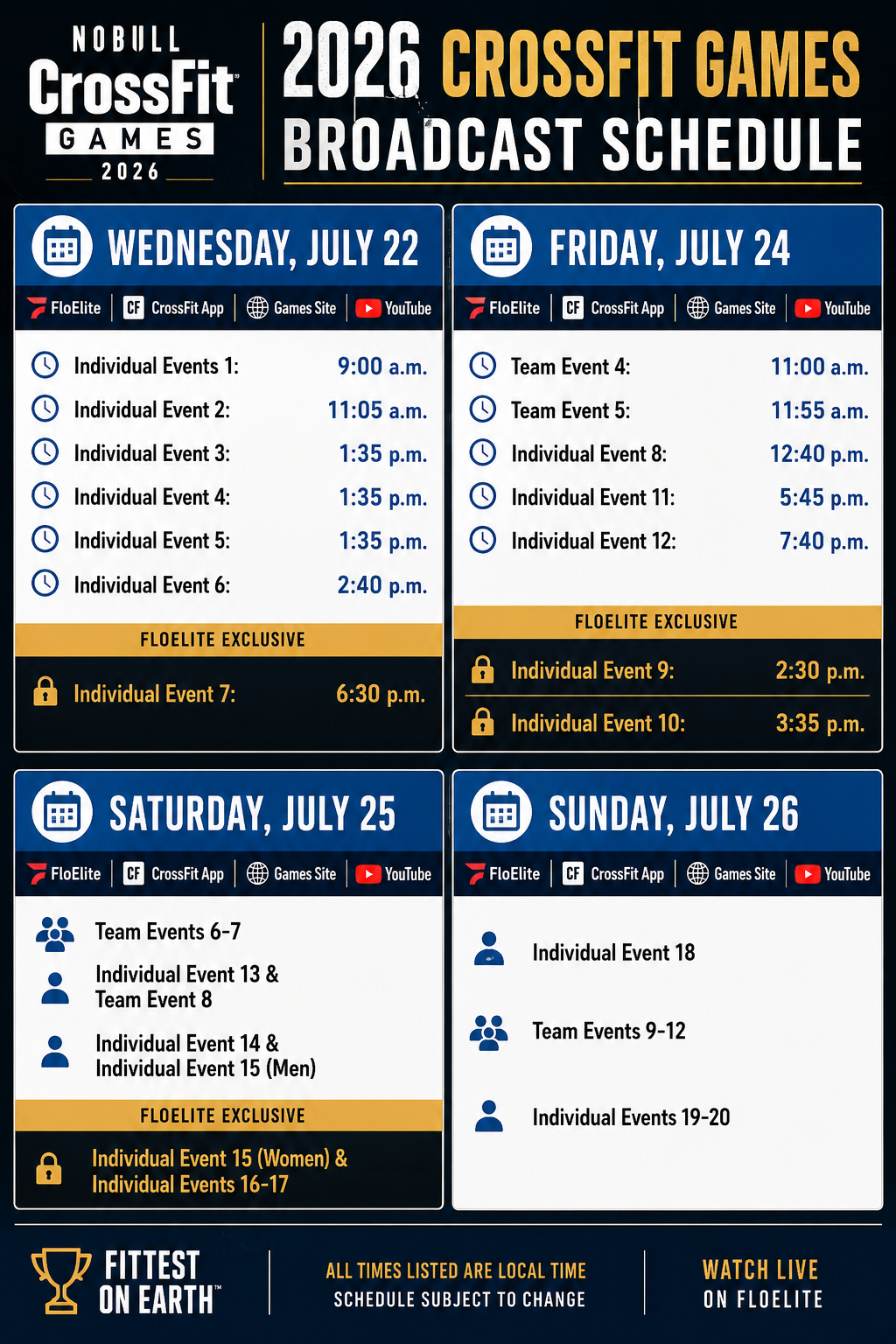
The Games are expected to stream through official CrossFit channels and partner broadcasts.

Official CrossFit Games site:
CrossFit Games

Tickets and finals info:
2026 Finals Overview

Qualifying leaderboard updates:
2026 Qualifiers