
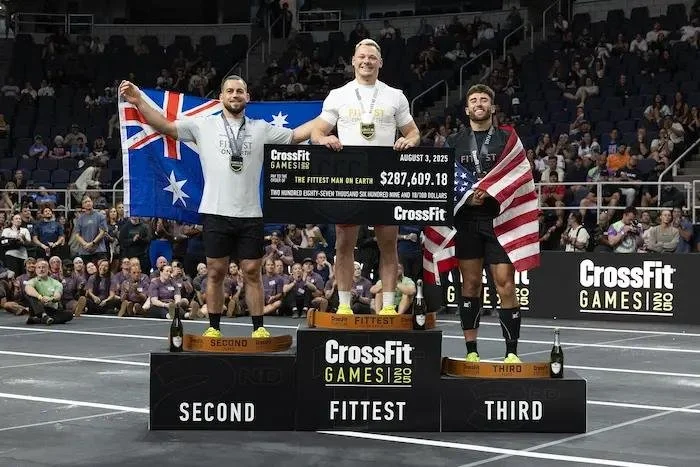
The road to the 2026 CrossFit Games in San Jose is beginning to take shape, and this season already feels different.
The sport is entering a transitional moment. Established legends are still standing, rising stars are no longer just prospects, and a new generation of athletes is beginning to challenge the hierarchy that defined CrossFit for the better part of a decade.
From redemption stories to title defenses, here are the biggest narratives building momentum heading into July.
Can Jayson Hopper Repeat?
Jayson Hopper enters 2026 with a completely different target on his back.
After capturing the men’s title at the 2025 Games, Hopper is no longer viewed as a talented athlete with potential. He is now the defending champion — and history has shown that winning once is very different from staying on top.
The pressure changes everything.
Opponents study weaknesses more aggressively. Expectations rise. Every event becomes a test not only of fitness, but of composure under the weight of defending a crown.
Hopper’s athleticism has never been questioned. His explosiveness, gymnastics capacity, and intensity make him one of the most dangerous competitors in the sport. The bigger question is whether he can maintain consistency across another full season against an increasingly deep men’s field.
If he does repeat, it would cement him as the face of the post-Fraser era.
Roman Khrennikov’s Last Push for a Title?
Roman Khrennikov remains one of the most respected athletes in CrossFit — and one of the most emotionally compelling.
For years, Khrennikov has battled injuries, visa complications, and heartbreaking near-misses while still remaining near the top of the leaderboard. His runner-up finish at the 2026 Mayhem Classic again proved he remains among the elite.
But time matters in CrossFit.
The sport is younger, deeper, and more athletic than ever before. Khrennikov still possesses world-class strength and work capacity, but the question looming over 2026 is whether this represents one of his final realistic opportunities to win the Games outright.
Fans continue to rally behind him because his career has become about perseverance as much as performance.
And if he finally captures the title in San Jose, it may become one of the sport’s most celebrated championship moments.
The Women’s Division Is Entering a New Era
The women’s field may be undergoing the biggest transformation in the sport.
For years, nearly every major storyline revolved around Tia-Clair Toomey and her historic dominance. Now, younger athletes are beginning to establish themselves as legitimate threats rather than future possibilities.
Athletes like:
Emma Lawson
Paige Rodgers
Lucy Campbell
Olivia Kerstetter
are no longer simply gaining experience. They are winning major qualifying events and entering Games conversations as potential podium athletes.
That generational shift creates one of the most fascinating dynamics of the season:
Can the veterans maintain control, or has the next era officially arrived?
Haley Adams’ Redemption Arc
Haley Adams may not currently be the betting favorite to win the Games, but few athletes carry more emotional support from the fan base.
After openly discussing burnout, mental health struggles, and stepping away from competition, Adams’ return has become bigger than leaderboard placement. Her performance at the Mayhem Classic showed flashes of the athlete fans remember, including an event win and moments of elite conditioning.
The question entering 2026 is not simply whether she can qualify consistently again.
It is whether a healthier, more balanced version of Adams can rediscover the confidence that once made her one of the sport’s brightest stars.
And if that happens, she immediately becomes dangerous.
Is This Finally the Year for Europe?
International athletes are no longer chasing American dominance — they are actively reshaping the sport.
Athletes from Europe continue flooding the top of leaderboards, and 2026 already reflects that trend. Victor Hoffer’s victory at the Mayhem Classic reinforced the growing international depth in the men’s division.
Meanwhile, athletes from Iceland, Australia, Canada, and across Europe continue producing elite contenders at nearly every stage of the season.
CrossFit’s center of gravity is becoming increasingly global.
The question now is whether the 2026 podiums will fully reflect that shift.
San Jose Changes the Atmosphere
The move to SAP Center for the Games’ 20th anniversary introduces another major storyline.
California carries symbolic weight in CrossFit history. The sport was born there, and returning west for such a milestone season feels intentional.
The venue itself may also change the feel of competition:
Faster-paced arena events
Louder crowds
More spectator-focused programming
Different climate and recovery conditions
Every Games location subtly alters the competition. Veterans who adapt quickly usually gain an advantage.
The Sport Is Evolving Again
Perhaps the biggest storyline is broader than any single athlete.
CrossFit itself is changing.
The athletes are younger. The training is more scientific. Recovery, nutrition, psychology, and specialization now play massive roles in performance. The gap between contenders and mid-level Games athletes continues shrinking.
That means 2026 may become one of the most unpredictable seasons in recent memory.
And unpredictability is exactly what makes the CrossFit Games compelling.