
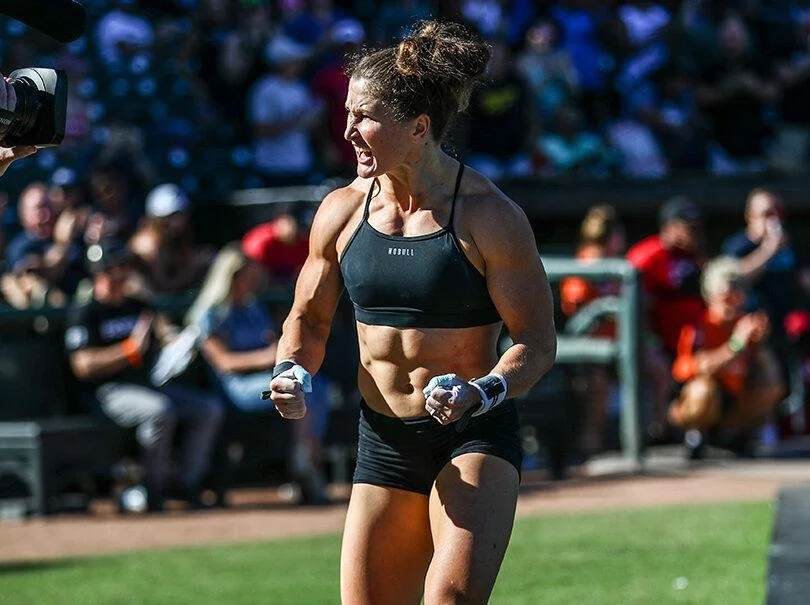
In a sport often dominated by massive personalities and headline-grabbing moments, Paige Rodgers has built her rise differently.
No dramatic theatrics. No manufactured persona. No constant noise surrounding every performance.
Instead, Rodgers has done something that may ultimately matter more in the modern era of the CrossFit Games:
She keeps getting better.
Year after year, workout after workout, Rodgers has steadily evolved from a respected competitor into one of the most complete and dangerous athletes in the women’s field. While attention often shifts toward bigger names and younger phenoms, her consistency and discipline have quietly positioned her among the elite contenders entering the 2026 season.
And at this point, calling her an underdog may no longer make sense.
Built Through Consistency
CrossFit rewards versatility unlike almost any other sport.
Athletes are expected to sprint, lift maximal loads, swim, climb ropes, perform elite gymnastics, and endure brutal endurance events — often all within the same weekend. The margin separating the podium from the middle of the leaderboard is razor thin.
Rodgers’ greatest strength may be her ability to minimize weakness.
She rarely implodes during events. Rarely appears overwhelmed. Rarely gives away unnecessary points. That level of consistency becomes increasingly valuable as the field deepens and the sport grows more competitive each season.
Many athletes can produce spectacular moments. Fewer can sustain excellence across an entire competition weekend.
Rodgers has steadily become one of those athletes.
The Evolution of a Contender
What makes Rodgers especially dangerous is that her development has appeared methodical rather than accidental.
Over time, her performances have reflected increasing maturity in pacing, strategy, movement efficiency, and composure under pressure. The physical tools were always present, but experience has sharpened how she applies them in competition.
That evolution is often what separates Games qualifiers from true title contenders.
The modern women’s field is brutally deep. One bad event can destroy an otherwise elite weekend. Athletes who remain mentally steady while adapting to unpredictable programming usually rise to the top.
Rodgers increasingly looks like an athlete capable of surviving that chaos.
The New Era of Women’s CrossFit
The women’s division is entering a transition period.
For years, the sport revolved around dominant veterans whose consistency created an almost impossible standard for challengers. Now, a new wave of athletes is beginning to emerge — competitors who grew up inside the CrossFit ecosystem and understand the demands of the Games from an early age.
Rodgers fits uniquely within that changing landscape.
She combines veteran-level experience with continued upward momentum, making her one of the more intriguing athletes to watch heading into the 2026 season. While younger stars generate excitement and established legends continue to command attention, Rodgers occupies a dangerous middle ground: experienced enough to manage pressure, but still improving physically and competitively.
That combination can produce breakthrough seasons.
Quiet Confidence
One of the most noticeable aspects of Rodgers’ competitive style is the absence of panic.
Elite CrossFit competitions are designed to create stress. Athletes are forced into uncomfortable positions, unexpected movements, and brutal fatigue. Emotional control becomes a competitive advantage.
Rodgers often appears remarkably composed regardless of circumstance.
That calm demeanor matters more than casual observers realize. In high-level competition, wasted emotional energy can become a liability. Athletes who remain efficient mentally often stay efficient physically.
Championship-level CrossFit increasingly resembles endurance warfare — not just physically, but psychologically.
Rodgers appears built for that environment.
Why 2026 Could Be Different
Every season produces athletes who feel poised for a leap.
Rodgers increasingly looks like one of them.
The physical capacity is there. The experience is there. The confidence appears to be growing. Most importantly, her trajectory continues moving upward at a time when the women’s field is becoming more volatile and unpredictable.
That does not guarantee a podium finish. The CrossFit Games remain one of the most unforgiving competitions in sports.
But it does mean Rodgers can no longer be viewed simply as a participant capable of qualifying.
She is entering the conversation as an athlete capable of seriously disrupting the leaderboard.
And if her progression continues, it may only be a matter of time before Paige Rodgers stops being described as a rising competitor and starts being described as one of the defining athletes of this new era in CrossFit.