
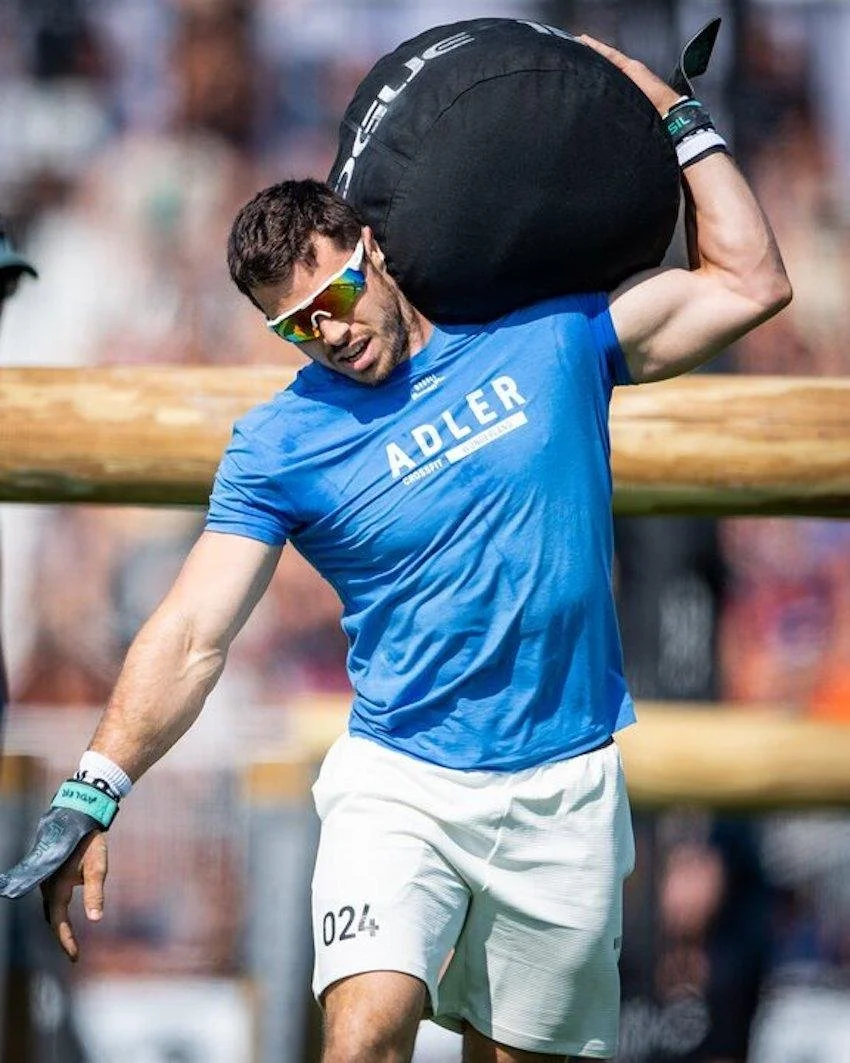
Winning the CrossFit Games changes an athlete forever.
Not just publicly.
Internally.
The climb to the top of CrossFit is brutal enough. Years of obsessive training, injuries, sacrifice, scrutiny, and survival all funnel toward one singular goal: proving you are the fittest athlete on Earth. But once an athlete finally reaches that summit, a different pressure emerges almost immediately.
Now you have to stay there.
For Jeffrey Adler, that challenge may define the next phase of his career more than the championship itself.
Because becoming champion transformed Adler from a respected contender into something far more dangerous: the standard everyone else is now chasing.
And heading into the 2026 season, one question looms over the men’s division more than any other:
Was Jeffrey Adler’s title the culmination of a great season—or the beginning of an era?
Adler’s rise never carried the same cinematic mythology as some of CrossFit’s larger personalities.
There was no dramatic reinvention.
No endless controversy.
No carefully marketed narrative arc.
Instead, Adler built himself through something less flashy and far more sustainable: relentless consistency.
Year after year, the Canadian athlete quietly evolved from respected competitor into one of the most complete athletes in the sport. While others dominated headlines with spectacular event wins or emotional storylines, Adler developed the type of profile elite competitors fear most—the athlete with almost no weaknesses.
In CrossFit, that matters more than brilliance.
The Games are not designed to reward perfection in isolated moments. They reward survival across chaos. The champion is rarely the athlete who looks most dominant for one afternoon. It is usually the athlete who refuses to collapse when the competition becomes unpredictable.
That is where Adler separated himself.
His greatness emerged not through spectacle, but through control.
While other athletes surged and faded, Adler remained stable. While others chased event wins recklessly, he accumulated points methodically. He became exceptionally difficult to damage across a full competition weekend, which is ultimately what championships require.
And perhaps most importantly, he learned how to manage pressure.
Pressure destroys many elite athletes long before injury does.
The modern CrossFit landscape magnifies everything. Every workout is dissected online within minutes. Every leaderboard swing becomes a narrative. Every weakness becomes public conversation. Athletes are expected to maintain elite conditioning while simultaneously functioning as media personalities, sponsors, content creators, and public brands.
Some competitors thrive under that scrutiny.
Others fracture beneath it.
Adler appears uniquely built for it.
There is an emotional steadiness to the way he competes that has become increasingly rare in modern CrossFit. He rarely looks panicked. Rarely looks overwhelmed. Rarely appears consumed by the emotional chaos unfolding around him on the competition floor.
That calmness is deceptive.
Because underneath it sits one of the fiercest competitive engines in the sport.
Adler does not need to dominate every event to control a leaderboard. He understands something many athletes struggle to fully embrace: the Games are won through accumulation, not emotion.
That philosophy helped elevate him from contender to champion.
Now it may determine whether he stays there.
The difficulty of defending a CrossFit title is often underestimated outside the sport.
Winning once is historically difficult.
Repeating is exponentially harder.
The moment an athlete becomes champion, they immediately inherit the psychological weight of expectation. Every competitor studies them differently. Every weakness becomes targeted. Every event suddenly carries the burden of validation.
The field stops asking whether you can win.
Now they ask whether they can take it from you.
For Adler, that dynamic becomes especially fascinating entering the 2026 season because the men’s field may be deeper and more dangerous than it has been in years.
Roman Khrennikov remains one of the most physically terrifying athletes in the sport when healthy. Younger stars continue emerging with increasingly advanced athletic backgrounds. Veterans refuse to disappear quietly. Specialists are evolving into complete athletes faster than previous generations ever managed.
And yet, Adler still may be the most structurally difficult athlete to beat over four days.
Because while others possess explosive strengths, Adler’s greatest weapon is balance.
He does not require ideal programming to contend.
He does not depend on one dominant category.
He does not unravel easily under pressure.
In a sport specifically designed to expose flaws, Adler has spent years systematically eliminating his.
That makes him exceptionally dangerous.
There is also a growing maturity to Adler’s presence within the sport.
Earlier in his career, he often felt like an athlete trying to break into the elite tier. Now he carries himself like someone fully aware that he belongs there permanently.
Championships change how athletes move.
You can see it in body language. Decision-making. Patience. The absence of desperation.
Adler no longer competes like a man hoping to prove himself worthy of the title conversation. He competes like someone who understands the conversation begins with him.
That distinction matters.
The best champions in CrossFit history shared a similar trait: they forced the field to react to them psychologically before workouts even began. Opponents stopped viewing them as merely another competitor and began viewing them as the obstacle standing between themselves and greatness.
Adler is entering that territory now.
And unlike some champions who rely heavily on momentum or emotion, Adler’s style may age exceptionally well. His success is built less on reckless athleticism and more on efficiency, preparation, pacing intelligence, and emotional control.
Those qualities tend to survive longer.
The move to San Jose for the 2026 CrossFit Games adds another layer of intrigue.
New venues reshape competitions in subtle but important ways. Arena pacing changes. Crowd energy changes. Recovery logistics change. Athletes who adapt quickly often gain enormous advantages early in the weekend.
Historically, Adler has thrived in precisely those environments.
He rarely appears rattled by unpredictability. In fact, chaos often seems to strengthen his competitive approach because he trusts his preparation enough to remain composed while others emotionally overextend themselves.
That composure may become critical if the 2026 programming trends heavier, longer, or more volatile than expected.
Because while explosive event wins create highlights, championships are still built on minimizing damage.
Few athletes in modern CrossFit do that better than Jeffrey Adler.
There is a temptation in elite sports to constantly search for the next superstar.
The next phenom.
The next viral athlete.
The next dramatic rise.
But sustained greatness rarely looks dramatic in real time.
Often, it looks disciplined.
Measured.
Quietly relentless.
That is what makes Jeffrey Adler so compelling as the 2026 season approaches.
He may not always command the loudest headlines. He may never cultivate the mythology surrounding some of the sport’s more emotional figures. But championships are not awarded for narrative appeal.
They are awarded for surviving the widest test in fitness better than everyone else.
Jeffrey Adler already proved he can do that once.
The terrifying possibility for the rest of the field is that he may only now be entering his prime.