
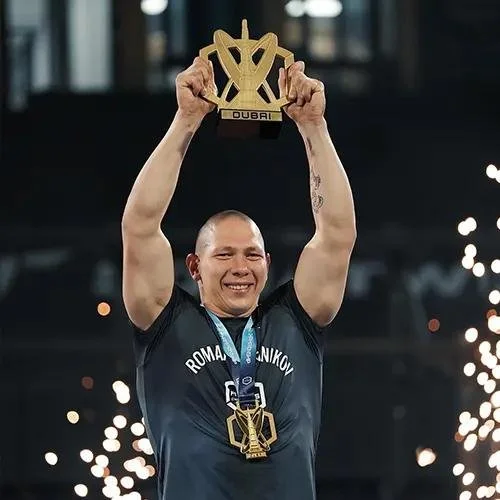
By the standards of elite sport, Roman Khrennikov should already be a champion.
Not a contender. Not a fan favorite. Not a perennial threat.
A champion.
For the better part of a decade, Khrennikov has existed in the rarest category in CrossFit: the athlete almost universally respected by competitors, feared by the field, and embraced by fans—yet still somehow missing the one title that would cement his legacy forever.
That tension has become one of the defining stories of modern CrossFit.
And as the sport barrels toward the 2026 CrossFit Games in San Jose, there is a growing sense throughout the community that Khrennikov may finally be entering the season where everything converges.
Talent.
Experience.
Health.
Timing.
For years, it felt like he only ever had three of the four.
Long before he became one of the sport’s most recognizable stars, Roman Khrennikov was already developing a near-mythical reputation inside competitive fitness circles.
Athletes talked about him quietly at first.
The Russian powerhouse with an endless engine.
The man who could crush heavy barbells without sacrificing pace.
The competitor who seemed almost impossible to break once momentum swung in his favor.
But for years, visa complications kept him from consistently appearing on the biggest stage in the sport. While others built careers and sponsorships under the lights of the Games, Khrennikov was forced to watch from the outside, his reputation growing largely through scattered appearances, international competitions, and whispered respect from those who had competed against him directly.
It created a strange aura around him.
He became CrossFit’s phantom contender—the athlete everyone believed could podium, maybe even win, but whom fans rarely had the chance to see tested against the full field.
When he finally arrived at the Games, the hype proved justified.
Roman did not compete like a man grateful simply to be there.
He attacked events.
There is an unmistakable violence to the way Khrennikov moves through workouts. Heavy barbells appear almost personal to him. Long endurance pieces become attritional wars where he refuses to slow down. Under fatigue, where many elite athletes become cautious and calculated, Roman often becomes even more dangerous.
He competes with emotional intensity that borders on reckless.
Sometimes that recklessness has cost him.
But it is also what makes him impossible to ignore.
The tragedy of Khrennikov’s career is not that he failed to become elite.
It is that every time he approached the summit, something intervened.
Injuries.
Breakdowns.
Momentum shifts.
Moments where his body betrayed the level of fitness his mind demanded.
The most painful examples have often arrived when a championship run felt realistic.
That is what separates Khrennikov from many fan-favorite athletes. His story is not built around potential anymore. Potential is hypothetical. Roman’s résumé already proves he belongs among the very best in the world.
The frustration comes from knowing how close he has already been.
CrossFit history is filled with athletes whose greatness was obvious before their titles arrived. But the sport is equally filled with cautionary tales—competitors who hovered near the top long enough for people to assume the championship would eventually come, only for time and injury to quietly close the window.
That possibility hangs over every veteran entering the 2026 season.
Especially Roman.
At 31 years old, Khrennikov now stands at a crossroads familiar to elite athletes across every sport. He possesses enough experience to understand exactly how to survive a Games weekend, yet still retains the physical explosiveness required to dominate it.
But CrossFit is unforgiving.
Every season introduces younger athletes with deeper developmental pipelines, more refined recovery systems, and years of specialized training beginning earlier than previous generations ever imagined.
Longevity at the top is no longer guaranteed by toughness alone.
It requires adaptation.
And that may be where Khrennikov has evolved the most.
Earlier versions of Roman often appeared emotionally combustible on the competition floor. You could see the desperation in certain events—the sense that he was trying to prove not only that he belonged, but that he deserved the respect he had been denied during years spent battling logistical barriers outside the arena.
Now, that desperation seems gone.
In its place is something colder.
More measured.
More dangerous.
The 2026 version of Khrennikov no longer feels like a man asking permission to stand among the elite. He competes like someone fully aware that he can beat anyone in the field when healthy.
That confidence changes everything.
Championships at the Games are rarely won solely through fitness. Nearly every athlete at the top possesses extraordinary capacity. The difference often emerges psychologically—through pacing decisions, emotional control, recovery between events, and the ability to remain stable while the leaderboard shifts unpredictably over multiple days.
Historically, that emotional volatility has sometimes worked against Roman.
Now it appears refined.
Not diminished.
Refined.
There is a maturity in the way he approaches competition that suggests he understands something many athletes take too long to learn: aggression alone does not win the CrossFit Games.
Controlled aggression does.
The move to San Jose for the 2026 Games may also create conditions uniquely favorable to Khrennikov’s style.
Arena environments amplify momentum athletes. Crowd energy matters more. Emotional swings become more visible. Big-event performers tend to rise faster under those conditions, especially athletes who feed off intensity rather than retreat from it.
Roman has always been one of those athletes.
And if the programming trends heavier—as many analysts expect—it could dramatically reshape the leaderboard.
Few competitors in the modern era combine brute strength and conditioning efficiency as effectively as Khrennikov. Workouts that force athletes to move heavy loads under exhaustion remain his most terrifying weapon. In those moments, he has the ability to erase deficits almost instantly.
Competitors know it.
You can often see it happen in real time during events. The field begins aggressively, trying to establish separation early, only for Roman to slowly impose himself as the workout deteriorates into pure suffering.
That ability to remain dangerous deep into fatigue is part of what has made him such a persistent threat at the Games level.
Even athletes who consistently finish ahead of him understand how thin the margin can become once Roman gains momentum.
There is another factor shaping the narrative entering 2026: urgency.
Not panic.
Urgency.
Roman Khrennikov understands better than most that championship windows do not remain open indefinitely.
Injuries accumulate.
Recovery slows.
Opportunities disappear.
There is a visible seriousness surrounding veteran athletes once they recognize that future chances are no longer guaranteed. The competition floor changes. The preparation sharpens. Distractions vanish.
For some athletes, that pressure becomes destructive.
For others, it becomes transformative.
The terrifying possibility for the rest of the field is that Khrennikov may finally be entering the phase where every lesson, every setback, and every disappointment becomes fuel rather than burden.
Because when fully healthy and emotionally balanced, Roman has already demonstrated that he can win individual events against anyone on Earth.
The only remaining question is whether he can sustain that dominance across an entire Games weekend.
If he can, the 2026 season may stop being remembered as the year Roman Khrennikov chased a title.
It may become the year he finally claimed the one that always felt within reach.
And if that happens, the victory will resonate far beyond the podium itself.
It will validate one of the longest, hardest, and most emotionally complicated journeys in modern CrossFit—a career defined not by easy ascension, but by relentless return.
For years, Roman Khrennikov has remained one of the sport’s most dangerous athletes.
In 2026, he may finally become its champion.