
For years, the women’s division at the CrossFit Games has been defined by dominance. Athletes like Tia-Clair Toomeyreshaped expectations of what was physically possible, creating an era where winning the Games often meant surviving a near-perfect performance from the top of the leaderboard.
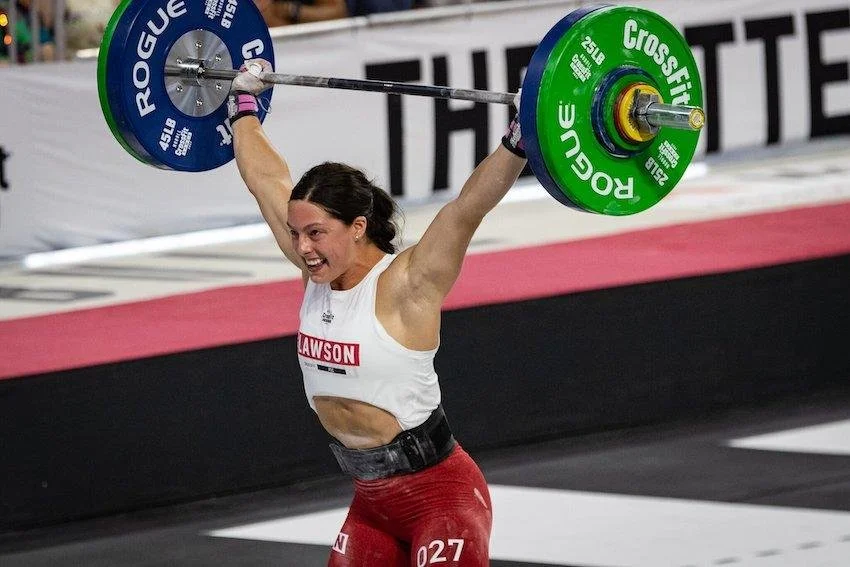
Now, another name is steadily moving into that conversation: Emma Lawson.
At just 20 years old, Lawson has already become one of the most compelling athletes in the sport — not simply because of her performances, but because of the way she performs. In a sport built on chaos, fatigue, and pressure, Lawson competes with a level of calm and consistency that feels far beyond her years.
That combination is why many in the CrossFit community increasingly view her as one of the future faces of the women’s division.
More Than a Breakout Athlete
CrossFit has seen plenty of young phenoms flash brilliance for a season before fading under the weight of expectations, injuries, or the relentless grind of the sport. Lawson appears different.
Rather than relying on one dominant specialty, her rise has been built on completeness.
She moves efficiently. She paces intelligently. She rarely panics during workouts. Most importantly, she avoids disastrous finishes — one of the defining traits of elite Games athletes.
In modern CrossFit, consistency often matters more than spectacular event wins. A competitor who repeatedly finishes near the top will almost always outperform athletes who swing wildly between first and fifteenth place.
Lawson seems to understand that already.
Across endurance workouts, gymnastics-heavy events, and mixed-modal tests, she has shown an ability to remain composed while other athletes begin to unravel. That steadiness has quickly transformed her from a promising prospect into a legitimate contender.
The Mental Side of the Sport
Physical talent alone does not win the CrossFit Games.
The competition stretches across multiple days and tests nearly every imaginable capacity: strength, conditioning, skill, recovery, pacing, adaptability, and resilience. The athletes who thrive are often the ones who can remain emotionally controlled while exhausted and under pressure.
Lawson’s composure may be the most impressive part of her rise.
Even during high-profile moments on the competition floor, she rarely appears rattled. There is little wasted movement, little visible panic, and little emotional volatility. Her performances often look methodical rather than desperate — a trait more commonly seen in seasoned veterans than in athletes still early in their careers.
That poise has drawn comparisons to Toomey, whose dominance was built as much on mental consistency as physical superiority.
The comparison is not about matching Toomey’s accomplishments — at least not yet. Rather, it reflects a similar competitive maturity that is unusual for such a young athlete.
A Changing Women’s Division
The timing of Lawson’s emergence matters.
The women’s field is entering a transition period. Veteran stars who have dominated headlines for years are moving deeper into their careers, while a younger generation is beginning to mature into true championship threats.
Lawson sits directly at the center of that shift.
She represents the next evolution of the sport: athletes who grew up watching modern CrossFit, training specifically for it from a younger age, and developing highly refined movement patterns before reaching their physical peak.
Unlike earlier generations that often transitioned into CrossFit from other sports, many younger competitors now arrive already molded by the demands of the Games environment.
Lawson appears to embody that evolution.
The Remaining Questions
Despite her rapid ascent, Lawson’s development is still ongoing.
The biggest remaining question is whether she can continue building the raw power and durability necessary to consistently win against the strongest women in the world. As athletes mature, maintaining health through increasingly brutal training volumes becomes one of the sport’s greatest challenges.
Heavy barbell cycling, maximal strength under fatigue, and long-weekend recovery remain critical areas that often separate podium contenders from champions.
Still, Lawson’s trajectory suggests those gaps may continue narrowing.
And perhaps most importantly, she appears unfazed by the expectations that now follow her into every major competition.
Why 2026 Could Be a Turning Point
The 2026 season feels increasingly significant for the future of women’s CrossFit.
As the sport prepares for another chapter at the SAP Center in San Jose, emerging stars are no longer simply chasing experience — they are chasing titles.
Lawson has already proven she belongs among the elite. The next step is determining whether she can take control of the sport’s next era.
That may not happen overnight. CrossFit history has shown how difficult it is to consistently stay at the top against the deepest fields in the world.
But if her progression continues at its current pace, it is becoming harder to view Emma Lawson merely as the future of the sport.
She is rapidly becoming its present.