
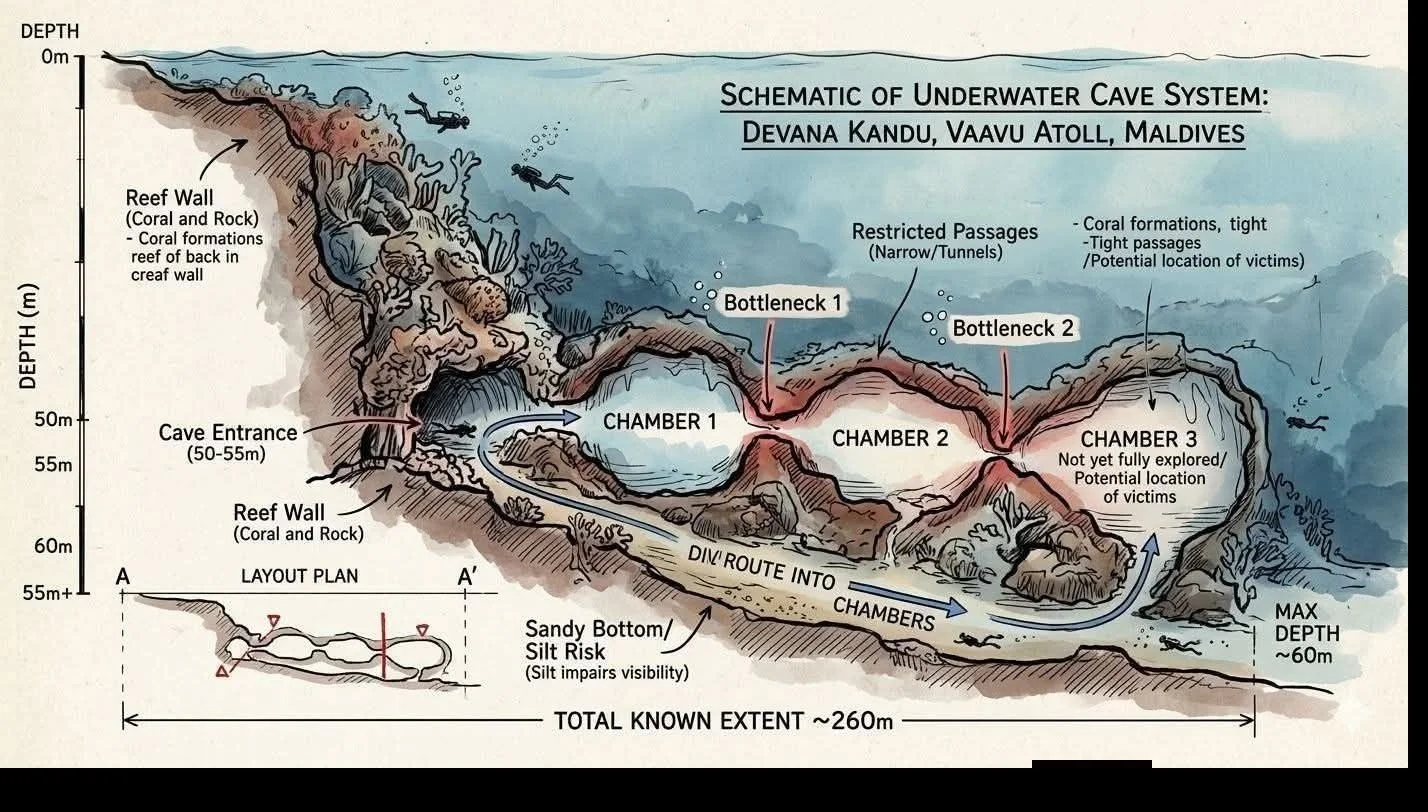
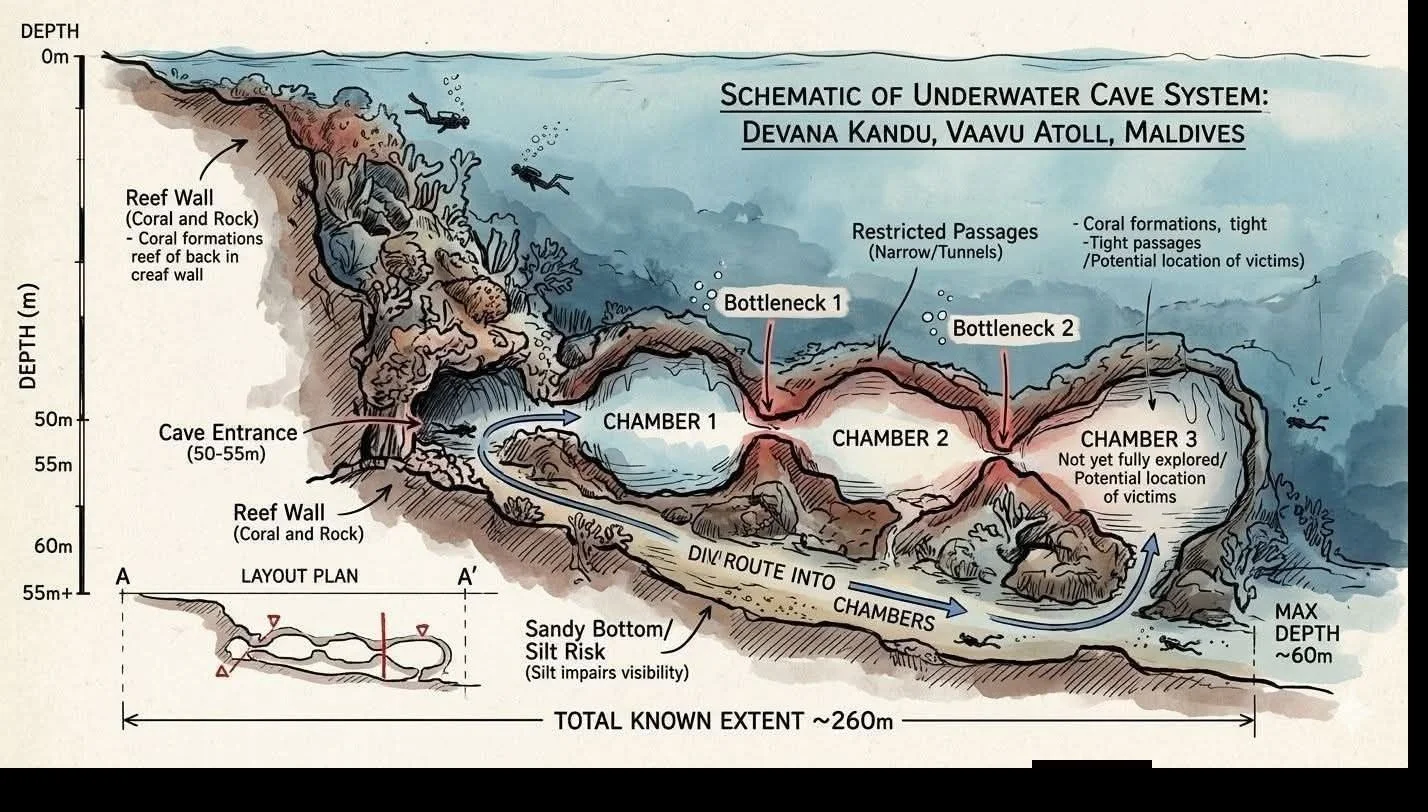
“Shark Cave”
I have been following this story since it was first reported. My heart goes out to the families of these poor souls who lost their lives in the extremely dangerous cave system in the Maldives known as “Shark Cave” near Vaavu Atoll. This cave is one of the most dangerous cave systems on earth and should not be entered without the right training and certifications. Someone once said “Divers better than you have died in caves like this”.
As much as officials continue saying, “we are investigating the incident,” to many of us in the diving community there already appears to be a very clear reason this tragedy likely occurred — and it may have been completely avoidable.
Beneath that postcard image of the Maldives lies another world entirely — dark cave systems, violent currents, crushing pressure, and an environment where even a small mistake can become fatal within seconds.
On Thursday, May 14, 2026, that hidden danger turned catastrophic.
Five experienced Italian divers entered a deep underwater cave system near Vaavu Atoll and never came back. A sixth man — Maldivian military diver Mohamed Mahdi, part of the recovery operation — also lost his life trying to retrieve them.
The victims included respected marine ecologist Monica Montefalcone, her daughter Giorgia Sommacal, research assistant Muriel Oddenino, marine biology graduate Federico Gualtieri, and dive instructor Gianluca Benedetti. Several had affiliations with the University of Genoa.
Authorities believe the group descended into the cave system locally known as “Shark Cave” or Devana Kandu, reaching depths estimated between 160 and 200 feet — far beyond standard recreational diving limits.
That distinction matters more than most people realize.
Everything emerging from this incident points toward a group of experienced divers entering an environment that demands highly specialized technical cave-diving training, equipment, procedures, and discipline. Experience alone is not enough in cave diving.
And that is where the public often misunderstands the danger.
Cave diving is not recreational scuba diving with a flashlight.
It is one of the most unforgiving disciplines in the diving world because once you enter a cave system, you lose direct access to the surface. If visibility disappears, a regulator fails, currents shift, or panic sets in, you cannot simply ascend. You must find your way out — often hundreds of feet from the entrance in darkness, under pressure, while managing limited gas supplies and decompression obligations.
At depths approaching 200 feet, there is almost no margin for error.
Reports suggest investigators are examining whether the divers were using the kind of redundant life-support systems and technical configurations normally associated with deep cave penetration diving. That includes sidemount or twinset systems, multiple redundant gas supplies, decompression planning, guide reels, bailout procedures, and specialized cave-diving protocols.
Those systems exist for a reason.
Interviews suggest that the divers were using standard recreational diving equipment which meant they were ill fated from the moment they entered the water with the intent to enter that cave system. Inside underwater caves, one frightened diver can create chaos instantly. A single misplaced fin kick can stir sediment into a blinding cloud, eliminating visibility completely. Once visibility disappears, direction becomes meaningless. Air consumption skyrockets. Panic spreads rapidly. At those depths, time is no longer on your side.
Investigators are also exploring other possible contributing factors, including oxygen toxicity, disorientation, powerful currents, weather conditions, and the possibility of a Venturi effect inside narrow cave passages that could have drawn divers deeper into the system.
But many experienced technical divers keep returning to the same core issue: training, preparedness and the lack of technical cave diving equipment.
One of the most dangerous misconceptions in diving is believing that years of diving experience automatically translate into cave-diving competence. They do not.
A diver can have thousands of recreational dives, years of ocean experience, and even professional instructor credentials while still being completely unprepared for a technical cave environment. Cave diving is an entirely separate discipline with its own procedures, psychology, emergency management, and survival requirements.
The ocean does not care about confidence.
The cave does not care about ego.
And experience without the proper training can become a deadly combination.
The recovery operation itself became another tragedy. The cave system proved so dangerous that the Maldives requested assistance from elite Finnish cave-diving specialists known for handling some of the world’s most difficult underwater recoveries. Before those teams fully took over, rescue diver Mohamed Mahdi died from decompression sickness during search operations.
His death underscored just how unforgiving this environment truly was.
Eventually, recovery teams located the bodies deep inside the cave system, some reportedly in the innermost chambers approximately 200 feet below the surface.
DAN Europe described them as a “highly specialised team” deployed specifically for this mission. Reports indicate they spent extensive time remapping the cave system, preparing equipment, and developing a recovery strategy before conducting the penetration dive that ultimately located and retrieved the victims.
Sami Paakkarinen and Patrik Grönqvist are already known in the technical diving community for their involvement in some of the world’s most difficult underwater recovery operations, including the infamous Plura cave incident in Norway — a mission later chronicled in the documentary Diving into the Unknown.
But what people outside the diving world may not fully understand is this:
Recovery divers do these missions knowing there may be no reward waiting for them except giving families a chance to bring loved ones home.
There is no fame at 200 feet inside a flooded cave passage.
No applause in total darkness.
No margin for error.
Only discipline, training, composure, and a willingness to accept enormous personal risk for people they may never have met.
In a tragedy filled with heartbreak, the actions of Sami Paakkarinen, Jenni Westerlund, and Patrik Grönqvist represent the very best of the diving community — professionalism, courage, and an unwavering commitment to bringing the lost home, no matter how dangerous the mission becomes.
Now investigators are trying to piece together exactly what happened. Questions remain regarding permits, equipment, dive planning, certifications, and whether the group exceeded the intended mission profile. Recovered GoPro footage may eventually reveal the divers’ final moments.
But cave-diving history already shows a brutal and consistent pattern.
Many of the world’s deadliest diving accidents involve highly experienced people pushing only slightly beyond safe margins — a little deeper, a little farther, a little longer than conditions allowed.
And underwater, small mistakes compound fast.
This tragedy should not simply be viewed as a freak accident. It should be a wake-up call about respecting environments that demand specialized training, specialized equipment, and absolute discipline.
For cave divers, there is an old saying:
“The cave does not care.”
And on May 14, 2026, six people paid the ultimate price to remind the world why.
Sometimes the most dangerous words in adventure are:
“I think I can handle it.”
https://www.daneurope.org/en/-/maldives?fbclid=IwY2xjawR7UHJleHRuA2FlbQIxMABicmlkETFTTmN1VUN3MEtucXV3YTNHc3J0YwZhcHBfaWQQMjIyMDM5MTc4ODIwMDg5MgABHnBiziAIoGDDTUvGA-TvzEkAMlItDfLccMMEuOj1sJtaRKtEmfZp4ai9Azql_aem_ad7djyEMWDSWvLzXYJDg5A